Crypto acquiring vs crypto payment gateway
Crypto acquiring and a crypto payment gateway: what the terms mean, how they differ from card acquiring, and what to check before you accept crypto.
People search for "crypto acquiring" and "crypto payment gateway" as if they were two products. They are not: acquiring is a card-payments term that is often borrowed for crypto, and the product behind it is a gateway. What actually matters is how accepting crypto differs from accepting cards.
The short answer
Crypto acquiring is a loose name for a service that lets a business accept crypto payments, used especially in Russian-speaking markets, where "acquiring" is the everyday word for taking payments. A crypto payment gateway is the technical product: it creates payments, tracks them on the blockchain and reports their status.
So in practice they are the same thing described from two directions. The useful question is not which name to search for, but how crypto payments differ from card payments and whether those differences suit your business.
How card acquiring works
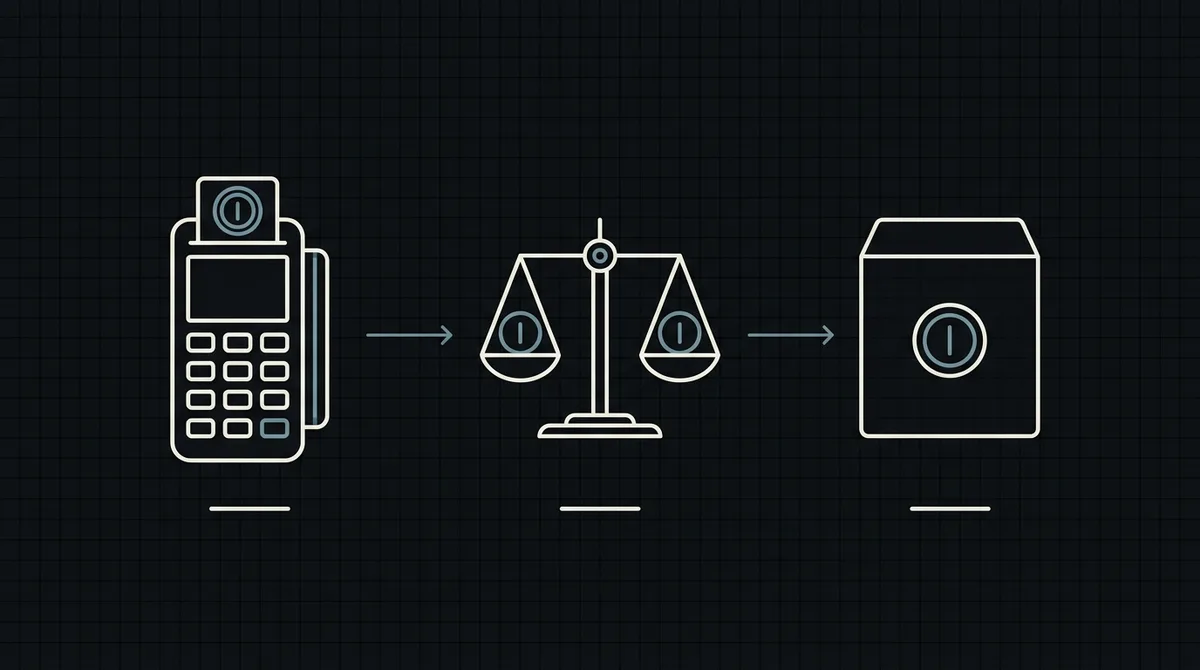
In a card payment, several parties sit between your customer and your bank account: the customer's issuing bank, the card network, your acquiring bank and a payment processor. The acquirer authorizes the payment, takes responsibility for it and settles the money to you after a delay. It also underwrites you as a merchant, which is why opening a merchant account involves checks, and it bears the chargeback process when a customer disputes a payment.
That structure gives card payments their familiar properties: a customer can dispute a charge, funds settle on the bank's schedule, and your business handles card data or hands that to a certified provider.
How a crypto payment gateway differs
Without banks and card networks in the middle, the model changes:
- The customer pushes the payment. They send a transfer from their own wallet; nobody "charges" their card.
- The blockchain is the settlement. There is no separate clearing step: once the transfer is confirmed, it is final.
- There are no chargebacks. A confirmed transfer cannot be reversed by the sender or a bank. A refund is a new transfer that you send.
- There is no card data. You do not handle card numbers, so card-data compliance does not apply to the crypto part of your checkout.
- Fees come from two places. The gateway charges for its service, and the network charges a fee for the transfer itself.
- It runs around the clock. Payments are not tied to banking hours.
- Price risk appears. If a customer pays in a volatile asset, the value moves between payment and withdrawal; stablecoins remove most of it.
The gateway's job is to make this look like an ordinary checkout from your side: one request to create a payment, one notification when it is final.
Side by side
- Who authorizes the payment. Cards: the issuing bank. Crypto: nobody; the network confirms the transfer.
- Can the customer reverse it. Cards: yes, through a dispute. Crypto: no.
- When do you get the money. Cards: after the bank's settlement delay. Crypto: when the transfer is confirmed, on your merchant balance.
- What you pay. Cards: acquiring and network fees. Crypto: the gateway's fee plus the network fee.
- What the customer needs. Cards: a card. Crypto: a wallet with the right asset on the right network.
- What you hold. Cards: a balance at your bank. Crypto: a balance at the gateway, withdrawn to your wallet.
Where the word "acquiring" causes confusion
"Crypto acquiring" suggests a bank-like service that turns crypto into money in your bank account. Some providers do offer that, but many gateways, including Qvard, pay out in crypto only. With Qvard, funds sit on a merchant balance and you withdraw them to your wallet, which costs only the network fee; there is no withdrawal to a bank account. If you need fiat, you convert the crypto yourself through an exchange or another service.
Check this before you sign up for anything called acquiring: ask whether you get fiat or crypto, in what currency, how fast, and what it costs.
Which one do you need
Crypto payments fit well when:
- your customers are international or already hold stablecoins;
- you sell digital goods, subscriptions or services where delivery is instant and chargebacks hurt;
- you want to receive money outside the banking schedule.
They are a weaker fit when you must pay suppliers in fiat the same day, when your customers do not use crypto, or when you cannot manage a refund policy without chargebacks. For most businesses crypto is an additional payment method next to cards, not a replacement.
Risk and accounting basics
Because nobody can force a refund, the risk shifts to you: fraud protection moves from the bank to your own order checks and delivery rules. Write a refund policy and decide how you will send refunds, since each one is a manual transfer.
Rules about taxes, reporting and licensing for crypto depend on the country and on your type of business. Treat this guide as general information and take advice from an accountant or lawyer in your jurisdiction before you scale up.
Where Qvard fits
Qvard is a custodial crypto payment gateway. You create a payment through the API, the customer pays on a hosted page in USDT or USDC on the major networks, or in BTC or LTC, and the final status reaches your server by webhook. Funds are credited to your merchant balance, and you withdraw them to your wallet automatically by rule or manually. The step-by-step integration is in how to accept crypto payments on a website, and the fundamentals are in what a crypto payment gateway is. To compare Qvard with other providers, see Qvard vs NOWPayments.
FAQ
Is crypto acquiring legal?
It depends on the country and on your business. Accepting crypto is allowed in many places and restricted in others, and tax and reporting rules differ. Ask a lawyer or accountant in your jurisdiction.
Are there chargebacks in crypto payments?
No. A confirmed blockchain transfer is final. Refunds are separate transfers that you send yourself, so a clear refund policy matters.
Can customers pay with a bank card through a crypto gateway?
Not through Qvard. The customer pays in crypto from their own wallet. A gateway that also accepts cards works differently and usually adds a conversion step.
Do I receive fiat or crypto?
With Qvard you receive crypto on your merchant balance and withdraw it to your wallet. There is no withdrawal to a bank account; if you need fiat you convert separately.