Crypto payments vs card payments
An honest comparison of crypto and card payments for a business: reach, chargebacks, refunds, fees, customer friction, accounting and when to offer both.
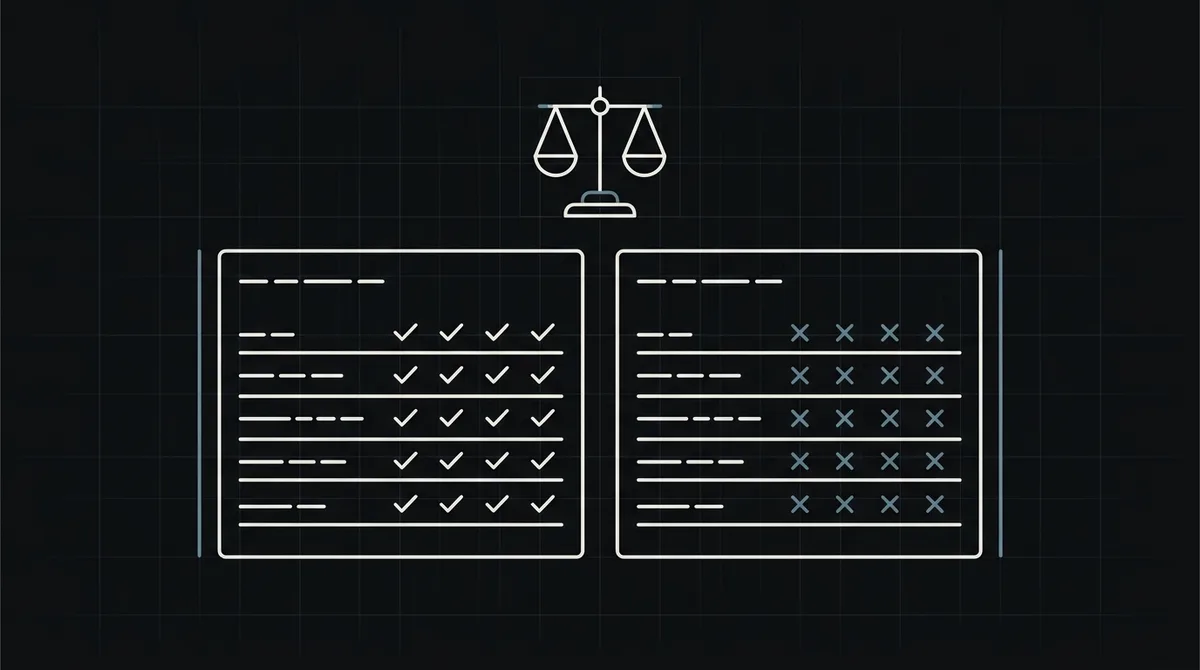
For almost every business the real question is not crypto or cards but whether adding crypto next to cards is worth the effort. They behave differently in ways that matter: who can pay, whether a payment can be reversed, what it costs and how it feels to the customer. This guide compares them point by point and says where each is the better tool.
Who can pay
- Cards are carried by nearly everyone in many markets and need nothing from the customer except the card. They fail when a bank declines a foreign or online purchase, when the card network or your processor does not serve the customer's country, or when the customer has no card.
- Crypto needs the customer to hold a stablecoin and a wallet or exchange account. That is a smaller group, but it includes customers the card rails fail: buyers in countries your processor does not cover, and people who already keep their money in dollar stablecoins.
Crypto therefore widens your reach at the edges rather than replacing cards at the centre.
Chargebacks and refunds
- Cards let the customer dispute a payment with the bank, which can reverse it weeks later. That protects buyers and is a real cost and risk for sellers, especially for instantly delivered goods.
- Crypto cannot be reversed by the sender. There are no chargebacks, so disputed-payment fraud on these orders is not a risk. The flip side is that a refund is a transfer you decide to send, to an address the customer gives you, and there is no network-level protection for a customer who pays the wrong address or network.
For a seller the absence of chargebacks is the main attraction; for a buyer it is the main reason to be careful. Put your refund rule in your terms.
Fees and getting the money
- Cards are priced by your processor: usually a percentage plus a fixed amount per transaction, sometimes a monthly fee, and settlement to a bank account after a delay set by the processor.
- Crypto through Qvard has no subscription fee and an individual commission that, per the pricing page, starts at 1% and can go down to 0.1%. The customer pays the network fee of the transfer. You keep the funds on your Qvard balance and withdraw them to your own wallet, paying only the network fee; withdrawal to a bank account in fiat is not available.
So the cost comparison depends on your volume and your card processor's terms, and the money-out step differs: crypto leaves you holding crypto unless you convert it yourself through a service you use.
Customer experience
- Cards: familiar, a few fields, one click for returning customers. Friction appears on declines and 3-D Secure steps.
- Crypto: the customer is redirected to a payment page, picks an asset and a network, and sends an exact amount from a wallet or exchange. It takes more steps, and a mistake, such as the wrong network or an amount reduced by an exchange fee, can cost money. The payment page shows the network and address together to reduce that, and a short payment gets the
partialstatus instead of silently succeeding.
Price stays in dollars with Qvard: you set the price in US dollars and the customer pays the equivalent in the chosen asset, at a rate fixed for one hour, so a stablecoin payment is not exposed to price swings in between.
Integration and operations
- Cards usually come as plugins or hosted checkouts for every big platform.
- Crypto through Qvard works through the API: your server creates a payment and receives a webhook when it is completed. There are no ready-made store plugins yet, so it takes a developer. See crypto payment API for developers and how to accept crypto payments on a website.
Operationally, crypto adds a few habits: mark an order paid only from the webhook, handle a short payment, reconcile against your balance, and plan how you take the money out.
Which to choose, and why most businesses offer both
A practical rule:
- Keep cards as the main way to pay wherever they work for your customers.
- Add crypto when you sell across borders, when card declines or chargebacks hurt you, when your customers or industry already use stablecoins, or when you want a payment route that does not depend on a card processor.
- Do not expect crypto to replace cards. Treat it as an extra option on the same checkout.
Accounting and tax treatment of crypto receipts depend on your country, so check them with your accountant before you launch. For the shop-side view, see crypto payments for ecommerce.
FAQ
Are crypto payments cheaper than cards?
It depends on your volume and your card processor. Qvard has no subscription fee and an individual commission that starts at 1% and can go down to 0.1%; compare it with your card terms, and remember that crypto adds a step when you take the money out.
Can a customer dispute a crypto payment?
No. The sender cannot reverse a crypto transfer, so there are no chargebacks. A refund is a transfer you send yourself.
Should I replace cards with crypto?
No. Offer crypto as an additional payment method for customers whom cards do not serve well, and keep cards as the main way to pay.
Can I withdraw crypto payments to a bank account?
Not through Qvard. Withdrawal is to a crypto wallet and costs only the network fee. Withdrawal to a bank account in fiat is not available.